This is not about AI anxiety. It is about the oldest problem in professional life, the gap between when change starts and when your response catches up to it, showing up in a new form.
What actually works is not more information. It is a structured way to diagnose your specific exposure, and a specific plan built around it.
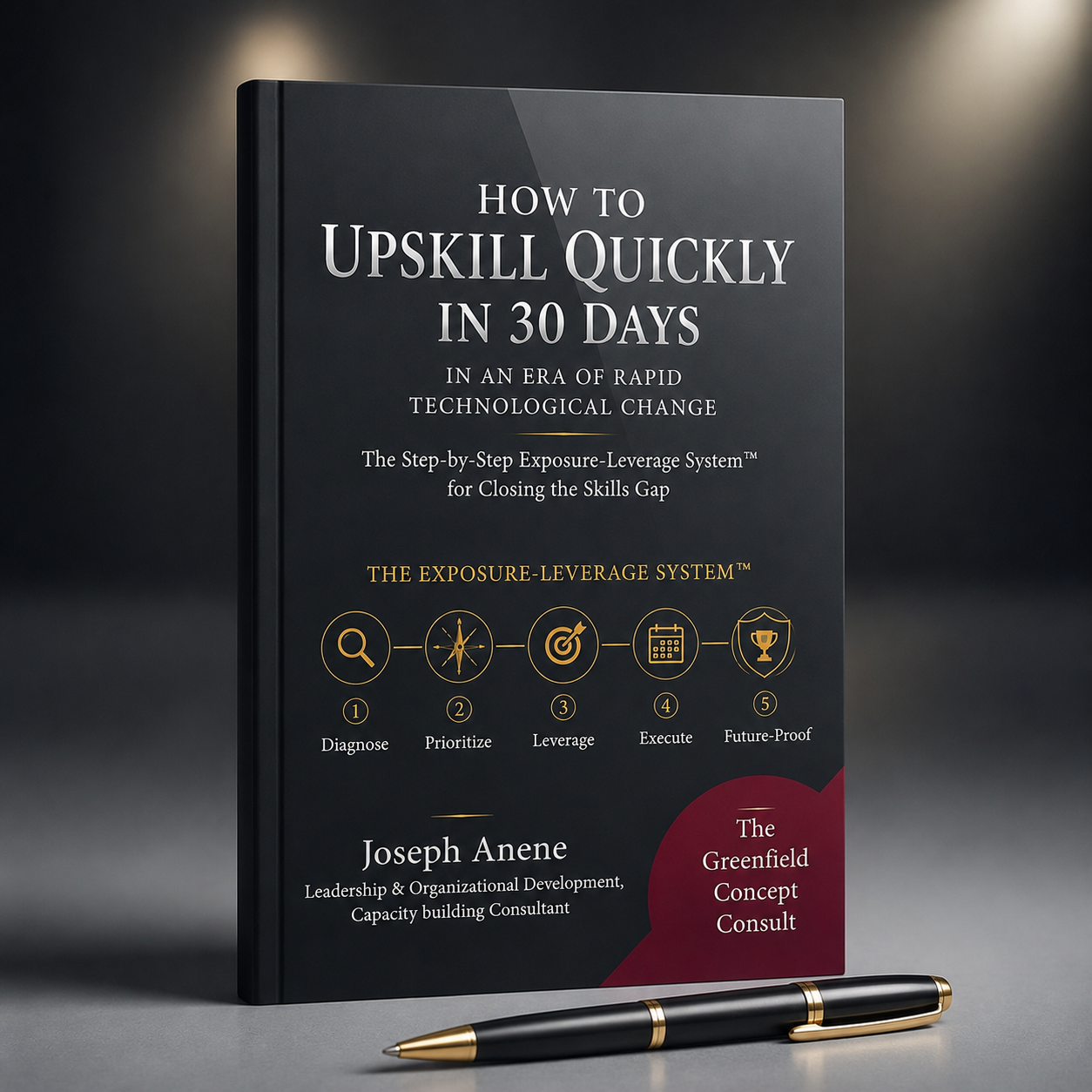
How to Upskill Quickly in 30 Days
A 66-page executive playbook: the full Exposure–Leverage System, the Executive and Worker tracks, and a complete Worksheet Companion appendix.
Core Framework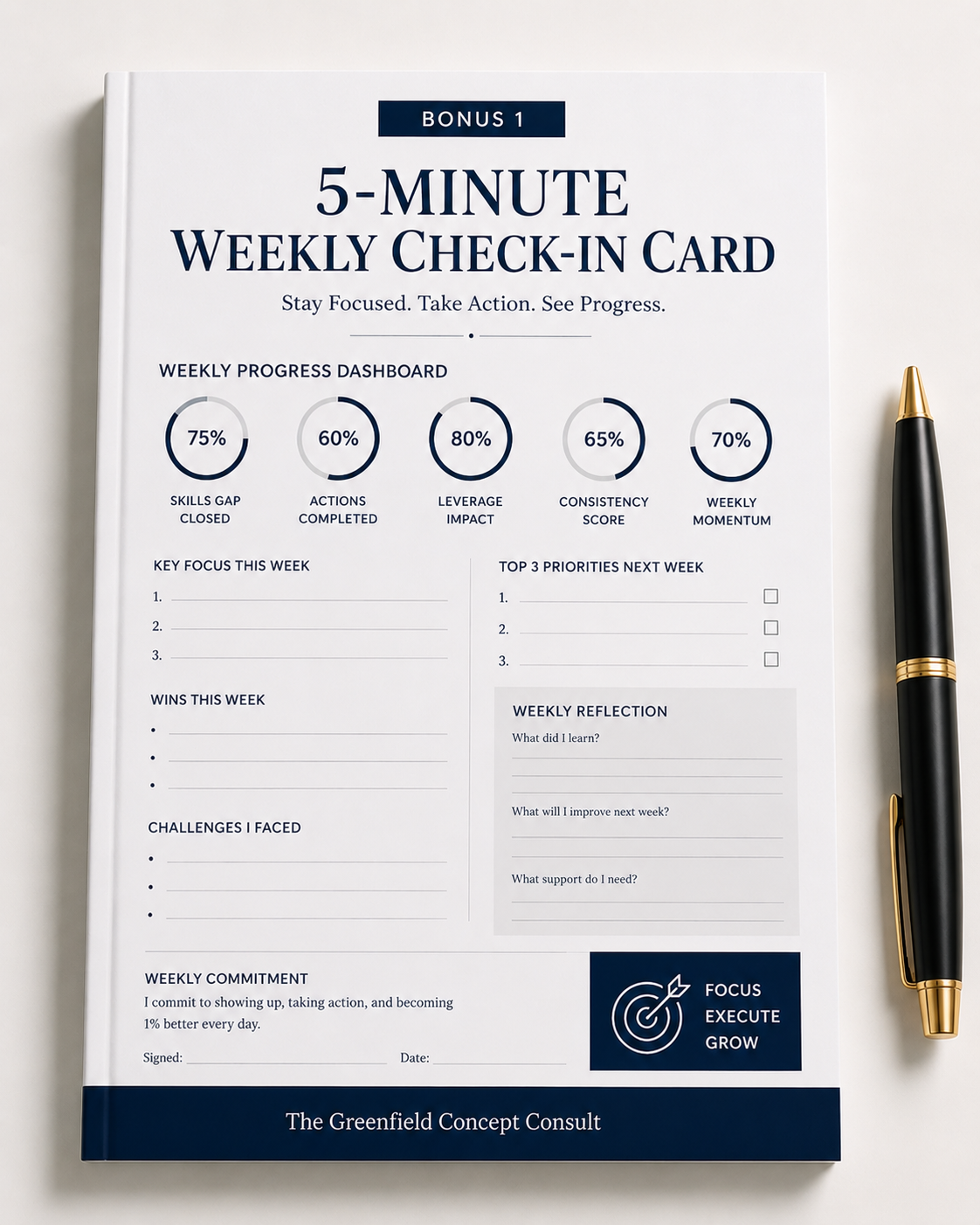
The 5-Minute Weekly Check-In Card
A printable weekly tracker that keeps your 30-day plan on track in under five minutes a week.
Implementation Tool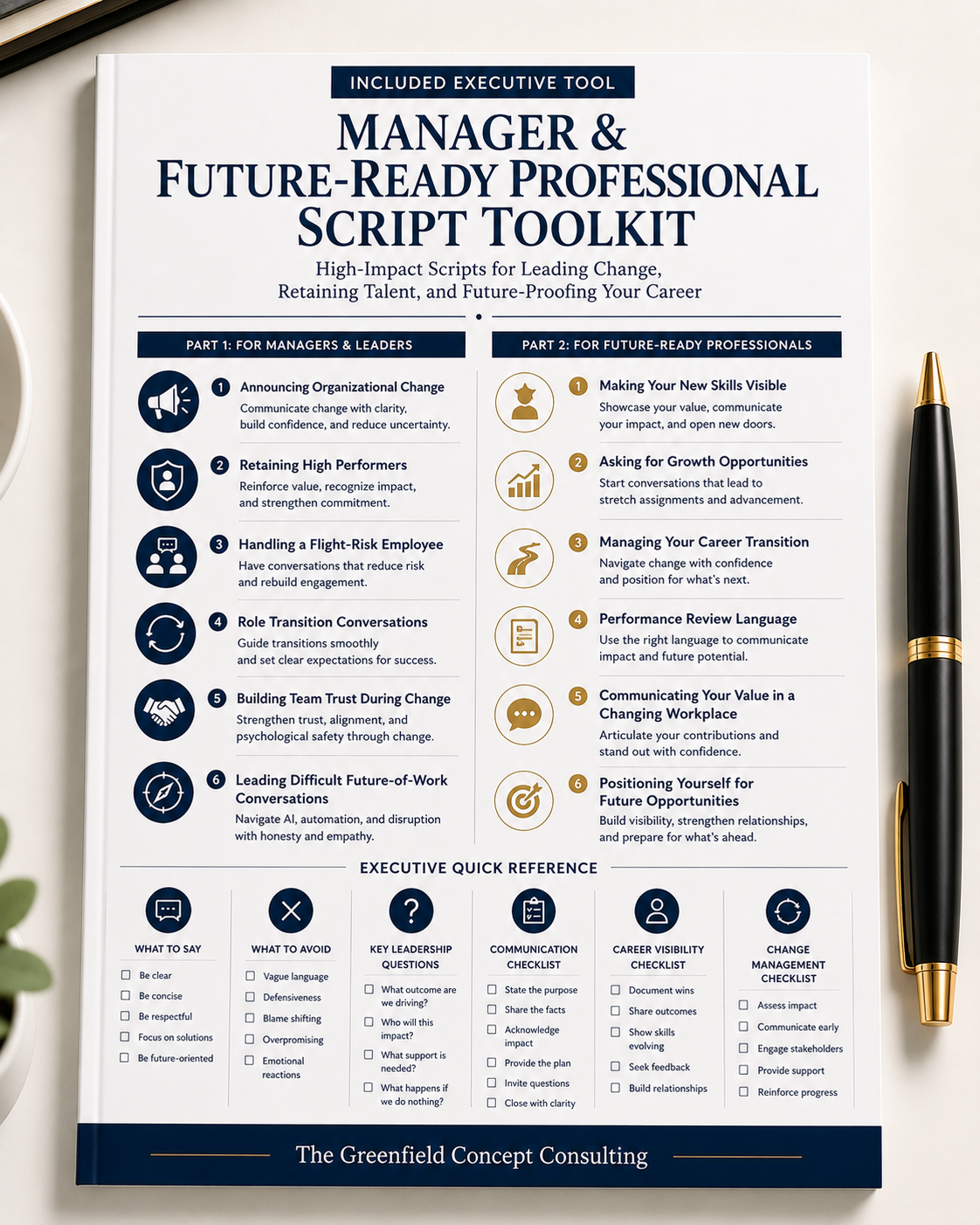
The Manager & Worker Script Cheat Sheet
Word-for-word scripts for the hardest conversations, condensed to two pages you can have ready before you need them.
Implementation ToolAdaeze was told to “figure out the AI rollout” for her department. The technical side did not worry her. What kept her up at night was simpler and harder: she could feel three of her strongest people quietly pulling back, and she did not know how to have that conversation before she lost them.
Working through the Exposure Score for her own role first, then for roles on her team, she found something she had not expected: the task she assumed was most at risk was actually low-stakes to automate, while a task she had overlooked entirely sat firmly in the zone that mattered most.
That is the opening script Adaeze used with her team, drawn directly from the Executive Track. Sequencing the conversation, rather than either staying silent or announcing before she could answer questions, changed how the entire rollout was received.
Tunde was not panicking, but he knew he needed to do something, and he did not know what was actually worth learning versus what was noise. He had a dozen bookmarked tutorials and had finished none of them.
Scoring his own role revealed something that surprised him: roughly forty percent of his week sat in the Resilient Zone, work built on long-standing client relationships no automation tool could replace. That gave him a concrete answer to protect and grow, instead of a vague sense that everything was at risk.
That is the kind of update Tunde learned to send using the Worker Track's visibility templates, climbing the ladder from quiet application to a real conversation with his manager, without it reading as anxious or self-promotional.

I am not an AI expert, and I will not pretend to be one here. What I am is a Leadership and Organizational Development Consultant with twenty years of experience helping people and organizations navigate exactly this kind of disruption, across public sector institutions, private companies, and everything in between.
The same two conversations kept showing up in almost every room I walked into. Executives who could handle the technical side of change but not the human side. Professionals who knew they needed to act but did not know where to start. Both were operating on a feeling. I built this framework to replace that feeling with an answer.
Twenty years watching who adapts well during disruption, and who does not, taught me one consistent pattern: it is rarely the most naturally gifted people who come through strongest. It is the ones who got a clear, honest read on their situation early, and built a plan around it.
Career stagnation. Staying in place while roles around you evolve is its own kind of falling behind.
Skill irrelevance. Not because you stopped being capable, but because you never got a clear read on where to focus.
Reduced opportunities. Growth and visibility rarely arrive by accident. They come from a case you can make, built on real evidence.
Losing your best people. For leaders, the cost of an unstructured rollout is rarely the technology itself. It is the talent that quietly walks away during the silence.
A single one-on-one consulting session with Joseph typically costs well more than this guide. This gives you the same core framework, in a format you work through on your own schedule.
This is not a purchase. It is a plan, built from twenty years of watching who comes through change strongest, and why.
Get the Guide + Both Bonuses Now